more cadmium in French people's bodies than in their European neighbours — Belgium, Italy, Germany, United Kingdom.
Transparent starches
Worried about cadmium and not sure what starches to give your children?
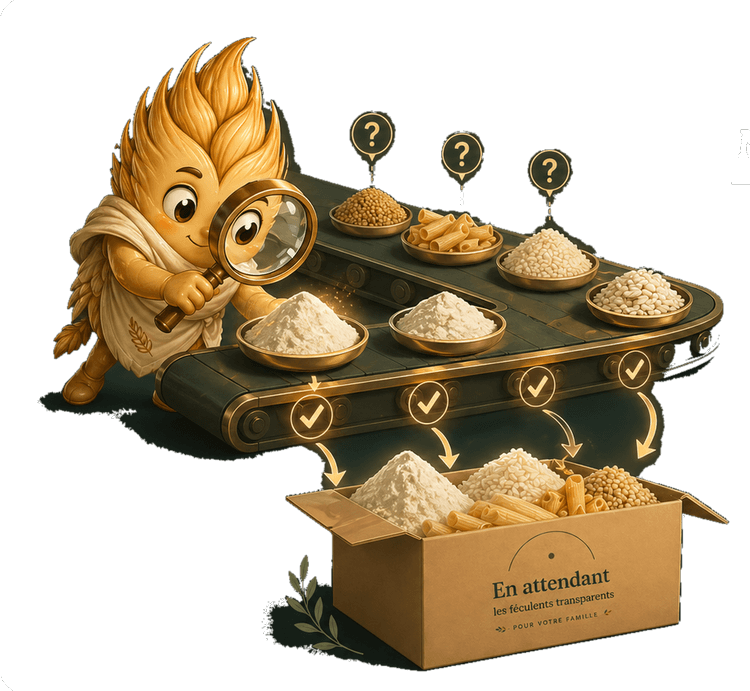
En attendant ("In the meantime") that supermarket brands publish their cadmium levels, we select producers willing to play the transparency game, and test the starches ourselves, lot by lot.
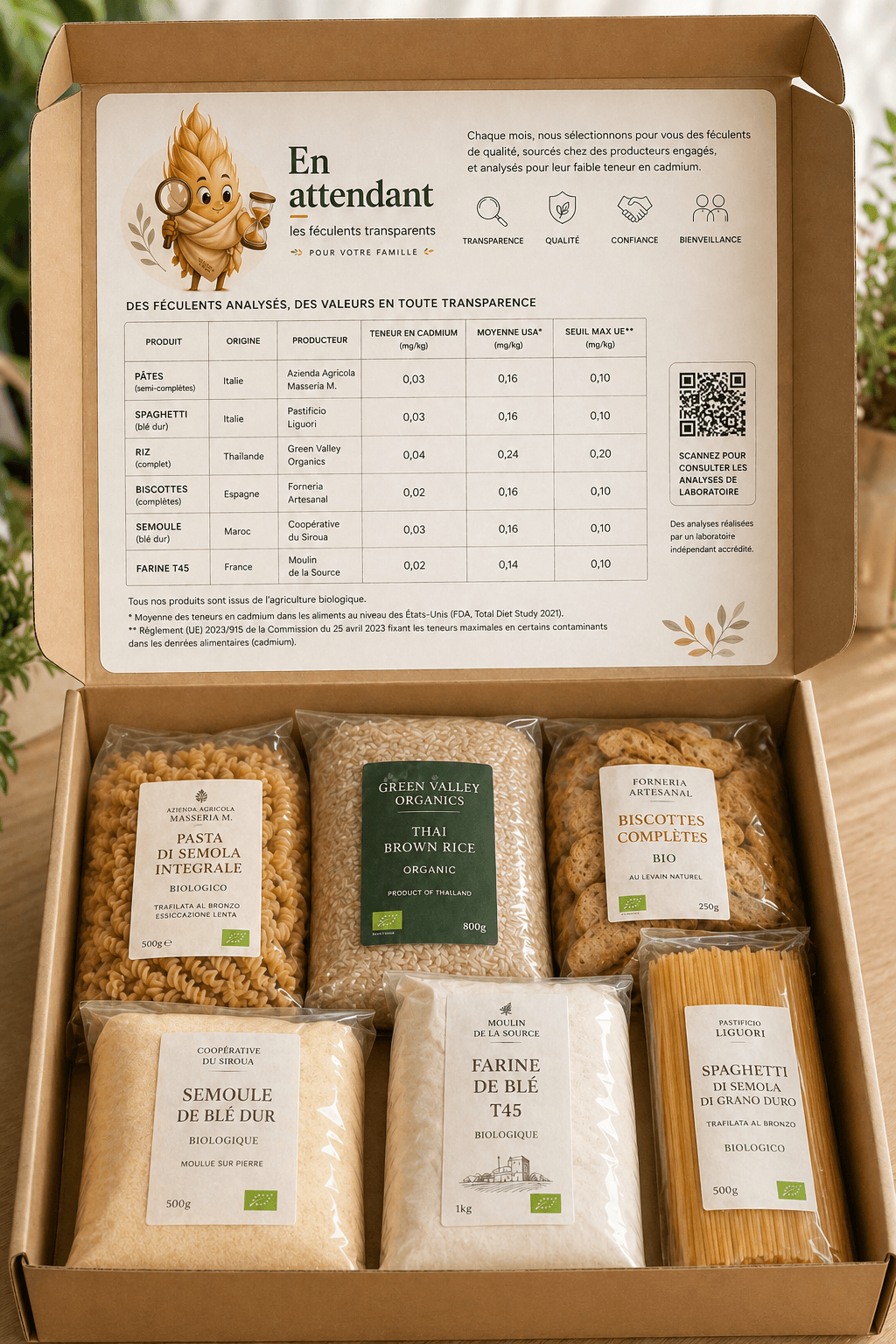
What next? We'll deliver the essential starches: pasta, rice, toast bread, flour, semolina.
Cadmium level
Lab results published for each lot.
Open project — designed to disappear once no longer needed.

Cadmium is a heavy metal classified by the EU as carcinogenic, mutagenic, and toxic to reproduction.
Yet 98% of our exposure comes from food.
more cadmium in French people's bodies than in their European neighbours — Belgium, Italy, Germany, United Kingdom.
of French adults exceed the critical urinary cadmium threshold.
of French children aged 2-3 exceed the health threshold set by ANSES.
Cadmium stays in the body for 10 to 30 years. Today's children start higher than we did at the same age. By summer, the French health insurance system is set to reimburse an individual screening test — but only for people living on polluted soils. And even if the result is alarming, no treatment exists.
And what about us?
Not anymore. The information is out.
Ever tried taking pasta or breakfast cereals away from a child?
For now, no transparency.
And we may wait a long time.
That's our choice.
Brand names invented for illustration; producer selection is still to be done.
Six basic starches, chosen for their place in the daily diet of both children and adults.
Producers may vary from month to month depending on analyses and supplies.
We'll let you know when the project launches (French families only).
Like many parents, I no longer know what to put on my children's plates.
With En attendant, I'll be able to feed my little girl and little boy (3 years and 9 months) without worry.
Act IIIt's in its DNA.
We test lot by lot and deliver starches that pass.
Transparency becomes a market standard.
Supermarket brands reach our levels.
The project stops. Mission accomplished.
And because no one should profit from parents' anxiety:
100% of profits donated
to an NGO working on food transparency (excluding reinvestment in development projects).
Salaries aligned with the median of social-economy companies.
No dividends.
Depending on who you are and what you want to contribute.
No advertising use of data — that's a promise.
Looking for farms that already measure cadmium in their lots, or that are ready to do so with us.
Would you have done it differently? Curious to learn more? Have advice to share? Contribute actively — a field report, an expertise, a contact, an idea — by sending me a message. I'll evolve the site and the wiki.
Or directly by email: bonjour@en-attendant.fr
If you have a question not listed here, write to me — I'll add it.
The reference reports are EAT2 (Total Diet Study 2, 2011) and EAT3 (February 2026), published by ANSES (the French Agency for Food, Environmental and Occupational Health & Safety).
The specific report on cadmium and dietary exposure is available here: ANSES Report — Cadmium and dietary exposure (PDF, in French).
Note: cadmium is classified by the European Union as carcinogenic, mutagenic, and toxic to reproduction. Cadmium catalogue · European Commission.
The plants that produce our starches — wheat, rice, maize… — absorb cadmium through their roots during cultivation. Three main sources: phosphate fertilisers massively used since the 1950s (which contain cadmium and accumulate it in soils), historical industrial pollution (former mines, atmospheric fallout), and the nature of certain soils.
Chocolate and potatoes also contribute to cadmium exposure (potatoes are estimated to account for 16-19% of total exposure according to ANSES).
But for the launch, these products are not well suited to parcel shipping: potatoes are perishable and don't handle long transport well, and chocolate requires cold-chain logistics to remain stable. Dry starches — rice, pasta, toast bread, flour, semolina — ship and keep without special constraints.
Honestly, the question isn't settled. Organic farming bans synthetic phosphate fertilisers, but some fertilisers allowed in organic — compost, manure, natural phosphates — can also contain cadmium. And historic soil pollution affects all farming methods.
That's why we test, organic or not.
Organic remains a sourcing priority, for another reason: it protects against other substances found in conventional starches — pesticide residues, synthetic fungicides, herbicides, traces of nitrogen fertilisers.
The EU maximum limit is set for an average adult exposure. But young children consume proportionally far more starches than adults, and they accumulate from their earliest years — across a whole lifetime ahead.
Dividing by 3 gives us a reasonable safety margin against this reality, without being prohibitive agronomically (producers can reach it). It's a commitment threshold, not an official standard.
Above all: we don't want French children, already exposed to soils more loaded than the European average, to end up more cadmium-burdened than their little European neighbours. Cadmium stays in the body for 10 to 30 years — aiming for this threshold directly limits the stock that accumulates.
No, the threshold varies significantly depending on the food. Some examples (in mg of cadmium per kg):
Polished rice: 0.15 mg/kg
Peeled potatoes: 0.10 mg/kg
Cocoa powder: 0.60 mg/kg
Chocolate: 0.30 to 0.80 mg/kg (depending on cocoa content)
Cereal-based baby food: 0.005 to 0.040 mg/kg (the strictest)
For cereals (wheat, pasta, flour, semolina, toast bread), new thresholds enter into force on 1 July 2026.
Our "3× below EU threshold" commitment therefore adapts to each food in the box. We aim for a cap three times lower than the corresponding official limit. For example, for rice: maximum 0.05 mg/kg.
Source: EU Regulation 2023/915 — Annex I on heavy metals in food.
France allows a much higher cadmium level in its phosphate fertilisers than most European countries. In mg cadmium / kg P₂O₅:
France (national-market fertilisers): 90 mg/kg
EU regulation (EU 2019/1009, CE-marked fertilisers): 60 mg/kg
Denmark: 48 mg/kg
Sweden: 44 mg/kg
Finland: 22 mg/kg
Hungary, Slovakia: 20 mg/kg
Massively used since the 1950s, these fertilisers released cadmium into soils decade after decade. With a higher cap than its neighbours, France has logically inherited more burdened soils.
A reduction trajectory was reportedly announced by the French Ministry of Agriculture on 25 March 2026, following the ANSES report: 90 → 60 mg/kg by 2027, 40 mg/kg by 2030, and 20 mg/kg subject to impact study before 2038.
With this trajectory, French soils would accumulate cadmium more slowly — but they would still accumulate, from a baseline already higher than the European average.
Because cadmium in starches isn't a brand characteristic — it's a soil and year characteristic. The level varies significantly depending on the plot, geology, past spreading, weather. From one harvest to the next, the same producer can produce lots with very different levels.
Testing a brand once gives no guarantee for subsequent lots.
No. Analyses are entrusted to a COFRAC-accredited French laboratory (the French Accreditation Committee), specialised in food contaminants. It's the only way to obtain results that are legally enforceable, reproducible, and auditable. We have neither the skills nor the accreditation to measure cadmium ourselves.
The lot doesn't go in the box. Our commitment (3× below the EU limit) is an entry condition, not a target. The producer will be required to take back the lot — this will be specified in the contract.
An app like Yuka or a comparator assumes public data exists by brand and by lot. But today in France, this data doesn't exist for cadmium in starches: no brand publishes it. En attendant first creates the data (by testing and publishing lot by lot).
An app or a label could come later, the day enough brands publish for comparison to be possible.
Because no supermarket brand currently publishes its cadmium level by lot. You can buy a cheap product, an organic product, a local product… but you don't know what's in it. The box gives you what the supermarket doesn't: the analysis, on every product, for every lot.
Rice, spaghetti, small pasta, toast bread, flour, semolina — these are the staples most children eat almost daily and which weigh most in cumulative exposure.
We excluded mueslis, sweet biscuits, prepared starch-based meals for a technical reason: these products combine several ingredients (multiple cereals, raisins, fruits, sugars…), which makes lab analysis much more complex and less reliable. On simple single-ingredient products, cadmium measurement is clean and reproducible.
Around 4 kg of dry products per month: rice 1 kg, spaghetti 500 g, small pasta 500 g, toast bread 300 g, flour 1 kg, semolina (to be confirmed). Calibrated to cover a significant portion — not the totality — of monthly consumption for a 3-4 person household.
Exact quantities will be adjusted based on selected producers and feedback from early subscribers.
Out of the €38 incl. tax per box (Mondial Relay delivery included):
€11-14 raw materials · €5.5-6 delivery · €1-2 lab cadmium analyses · €1.5-2 packaging · €0.8-1.2 inbound transport · €0.7-1 banking fees.
Remaining is a gross margin of €8-14 that goes first to pay for work (one salary at launch, several later: it's a big job) and to cover fixed costs (insurance, accounting, hosting, safety reserve). Anything beyond is donated to an NGO working on food transparency (excluding reinvestment in En attendant's development projects). It's a cost-based price, not a positioning price.
To keep costs down, we remove anything that doesn't serve the promise: no decorative tissue paper, no recipe booklet, no premium packaging. The goal is cadmium transparency — not marketing.
€38/month remains an effort. Three avenues to make the box more accessible over time:
Municipal subsidies · on the model of organic baskets for pregnant women that some town halls already fund. Nurseries and schools · deliver in larger quantities to collective structures, to lower unit cost. Solidarity pricing · if the project reaches break-even, redistribute part of the profits as discounted boxes for lower-income families.
These avenues will be built with interested local authorities.
First a quick note: €38 is a working price hypothesis, not a fixed rate. It will be refined with quotes from analytical labs and depending on the conditions of the first selected producers.
Yes, it's almost double the price of organic starches in supermarkets. Why this gap? Because each box absorbs the additional costs that don't apply to mainstream brands: importing the starches, shipping to a pickup point, and above all the cadmium analyses in an accredited lab, lot by lot.
The more subscribers there are, the lower the price can drop: analyses spread over a larger volume, producers accept better terms, logistics become more efficient.
Three avenues to make the box more accessible over time:
Municipal subsidies · on the model of organic baskets for pregnant women that some town halls already fund. Nurseries and schools · deliver in larger quantities to collective structures, to lower unit cost. Solidarity pricing · if the project reaches break-even, redistribute part of the profits as discounted boxes for lower-income families.
We're well aware that not everyone will be able to afford it. These institutional partnerships are a priority, to be built with interested local authorities.
Over 12,000 pickup points across France allow us to keep delivery under €6. Home delivery would cost at least €3 more per box.
Other options will be considered later based on subscriber feedback.
We're aiming for a launch during 2026. Before that, we need to secure a minimum subscriber volume (to amortise the cadmium analyses and the starch import costs), find the first producers, and likely run a crowdfunding campaign with pre-orders to fund the launch.
If you want to be notified as soon as we start, sign up via the form at the bottom of the page (French families only).
Many ways — all useful at different stages:
Share your view · your perspective as a parent, healthcare worker, teacher or farmer matters to refine the project. Spread the word · talk to your circle, your nursery, your canteen. Connect · with a producer, a lab, a journalist, an association. Co-lead · if you're an entrepreneur looking for your next project, the wiki is open.
Everything goes through the "Improve the project" form above, or to bonjour@en-attendant.fr.
Yes, the project is time-bounded. The day we find in supermarkets or local organic shops one or two brands per category (rice, pasta, toast bread, flour, semolina) that display their cadmium level at a level comparable to ours, we'll close.
"En attendant" (French for "in the meantime") — the name says the mission: we exist in the meantime, until transparency becomes the norm.
All levers are useful — NGO advocacy, political action, research, entrepreneurship. None is enough alone.
The only one I really know how to use is entrepreneurship. So I play with what I master. That doesn't stop me from supporting, in parallel, the associations fighting on the topic — financially or on their ground.
Influencing policy takes time. Reforming a European cadmium standard can take 5 to 10 years. My children can't wait. Creating a business immediately produces the missing data: no brand currently publishes its cadmium level per lot. By testing and publishing, En attendant builds the foundation on which a label, regulation or app could exist tomorrow.
Because it's not a personal brand, and En attendant is meant to be taken on by others. Putting my photo or last name in the spotlight would amount to embodying the project as my company, which it isn't.
For now, En attendant is just an idea that has cost €0: this site was built with Claude (AI), without any agency or fundraising round.
The idea is meant to become a company whose shareholders are the project's co-leads. No outside investors, no food-industry players in the cap table. And therefore no possible conflict of interest.
The actual launch will happen via pre-orders during a crowdfunding campaign, provided the waitlist gathers enough sign-ups to make the model viable.
And then that's it: we'll stay independent. No food or industrial company will ever be a shareholder.
Four steps, zero opacity.
One protocol, repeated lot after lot.
Source the producers
Those located where soils are low in cadmium, or who voluntarily share their measurements. Organic farming prioritised.
Test every lot
Systematic cadmium analysis in a French COFRAC-accredited laboratory. Lot by lot — not through a single annual sample.
Publish the results
The level is reported on the card included in the box. Full lab report public. No averages — the exact measurement of the lot sent to you.
Deliver to a pickup point
To a pickup point (to start with), near home, every month. Delivery included in the box price. No commitment.
Tested lot by lot.
3× below the EU limit.
No exception.